Glass vs plastic food storage: which is better?
Research-based: built from manufacturer specs and published studies. Not a hands-on test.
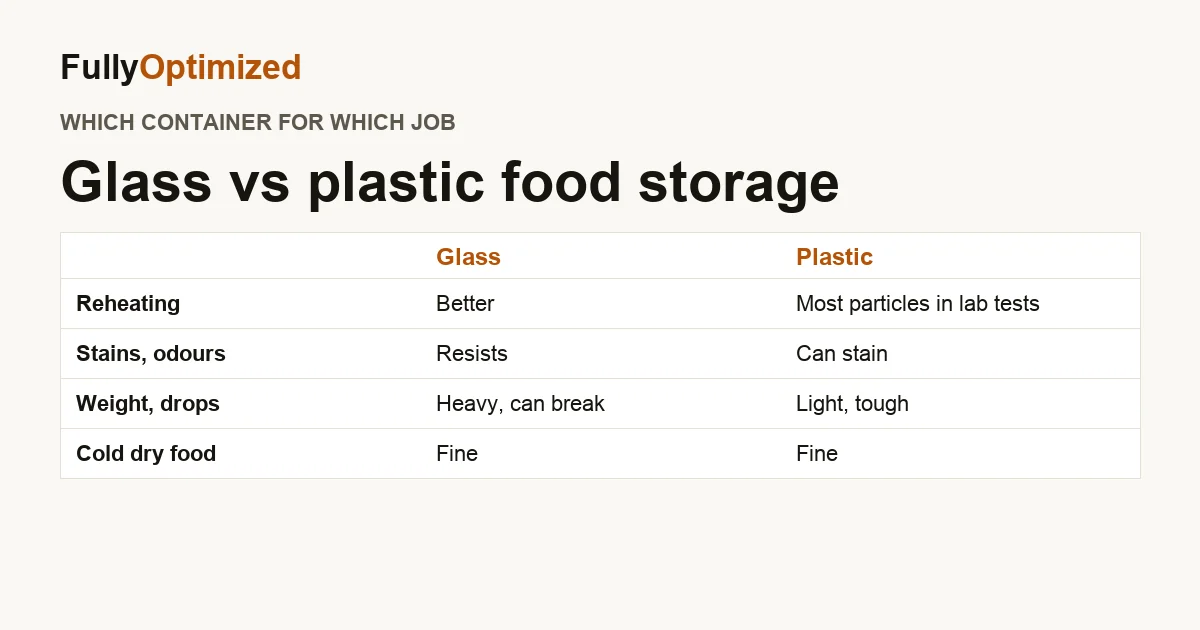
Side by side
| Glass | Plastic | |
|---|---|---|
| Microwave | Glass base is microwave safe; lid rules vary | Some containers can melt; check the label[3] |
| Particle release when heated | None from the glass itself | Highest when microwaved, in lab tests[1] |
| Stains and odours | Resists stains, does not absorb odours (Pyrex)[4] | Tomato and curry can stain |
| Weight and drops | Heavy; can break | Light; survives drops |
| Oven | Glass base, if the maker allows it | No |
| Lid | Usually still plastic | Plastic |
Heating is where they differ most
A 2023 University of Nebraska study tested polypropylene containers and a polyethylene pouch with water and a mild acid standing in for food. Microwaving released far more micro- and nanoplastic particles than fridge or room-temperature storage, up to 4.22 million microplastic and 2.11 billion nanoplastic particles per square centimetre of plastic in three minutes for some containers.[1] Polypropylene is a common BPA-free plastic (Glasslock's lids, for example, are polypropylene sold as BPA-free), so a BPA-free label does not address particle release.
Keep the evidence in proportion. The FDA's position is that current evidence does not demonstrate that the microplastics detected in foods pose a risk to human health.[2] Choosing glass for hot food reduces one exposure that is easy to avoid. Nobody has shown that it improves health.
What about BPA?
Many plastic food containers are now labelled BPA-free. Regulators disagree on how much BPA matters at the levels people actually take in. Health Canada says current dietary exposure from food packaging is not expected to pose a health risk to the general population, including infants.[5] EFSA in 2023 set a far lower tolerable daily intake and concluded that people in all age groups exceed it.[6] Glass and stainless steel sidestep the question for the container body. The lid is usually still plastic.
When plastic is still the right call
Plastic is light and does not shatter. For cold, dry food like crackers, nuts or pasta, it is the lowest-heat use there is. Keep those containers until they wear out. For packed lunches where glass is too heavy or risky, stainless steel is the middle ground: see stainless steel food storage, compared.
If you are switching to glass
For a mostly-reheat routine, a press-fit set such as Pyrex Simply Store (paid link) is simple, and Pyrex rates its lids microwave safe.[4] For carrying soups and sauces, a locking, gasketed lid such as Glasslock (paid link) travels better. If you want no plastic touching the food at all, a steel and silicone container like the ECOlunchbox Splash Box (paid link) does that, though it cannot go in the microwave. The full head-to-head is in Pyrex vs Glasslock, and the glass types are explained in is borosilicate glass safe?.
Back to the plastic-free kitchen guide.
Common questions
Are glass meal prep containers better than plastic?
For meals you reheat, yes. Glass can go in the microwave without the particle release measured from plastic in lab tests, and it does not stain or hold odours. Plastic is lighter and does not break, which matters if you carry several meals a day.
Is BPA-free plastic safe to microwave?
BPA-free does not mean particle-free. The 2023 Nebraska study tested polypropylene containers, a common BPA-free plastic, and microwaving still released the most particles of any use it tested. The FDA says current evidence does not show these particles in food harm health, but if you want to avoid them, reheat in glass.
Do glass containers last longer than plastic?
The glass usually outlasts its lid. Plan on replacing lids over time, and favour brands that sell replacement lids.
Get new sleep and recovery reviews by email
One email when we publish a new hands-on review or a major update. No daily newsletter.
Sources
- Hussain et al., Environmental Science & Technology 57(26), Assessing the Release of Microplastics and Nanoplastics from Plastic Containers and Reusable Food Pouches (2023-06-21)
- U.S. Food and Drug Administration, Microplastics and Nanoplastics in Foods (content current as of 2024-07-24)
- U.S. Food and Drug Administration, Microwave Ovens (checked 2026-10-17)
- Pyrex (Corelle Brands), Pyrex Simply Store product page (checked 2026-10-17)
- Health Canada, Bisphenol A (BPA) in food packaging (checked 2026-10-17)
- European Food Safety Authority, Bisphenol A in food is a health risk (2023-04-19)