The best stainless steel food storage containers, compared
Research-based: built from manufacturer specs and published studies. Not a hands-on test.
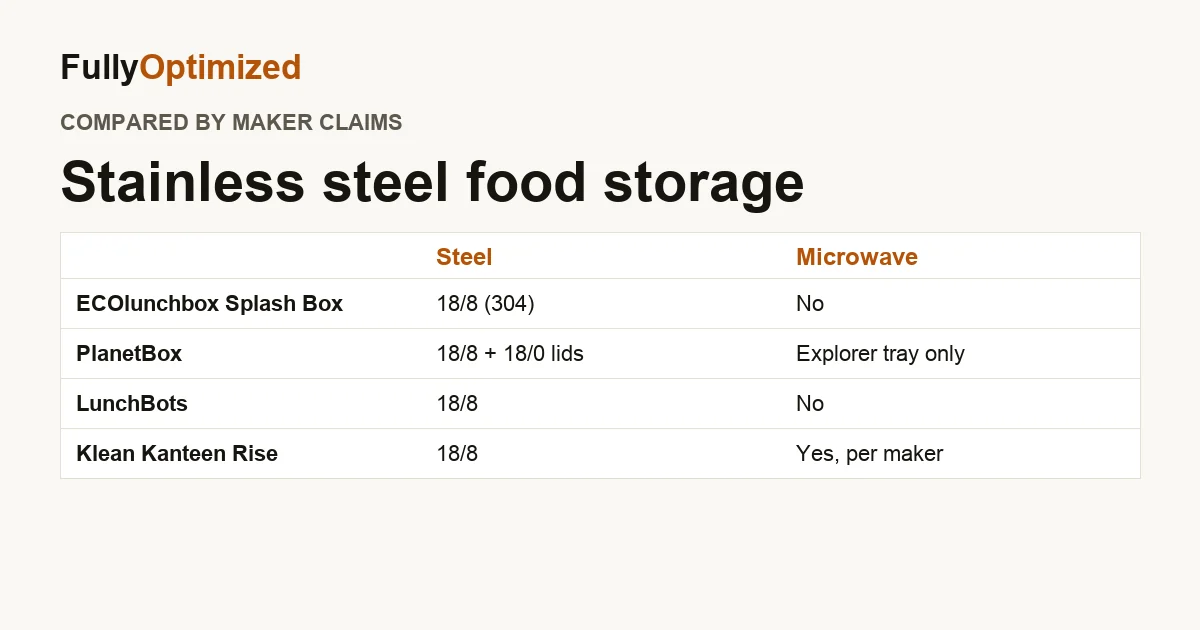
Quick comparison
| Container | Steel | Lid | Leak-proof claim | Microwave |
|---|---|---|---|---|
| ECOlunchbox Splash Box | 18/8 (304)[1] | Silicone | Yes ("no-leak") | No[1] |
| PlanetBox | 18/8 body, 18/0 lids[2] | Steel; silicone on some models | Voyager and Explorer[2] | Explorer's removable tray only[2] |
| LunchBots | 18/8[3] | Steel or plastic, by model | Not stated in FAQ | No[3] |
| Klean Kanteen Rise Food Box | 18/8[4] | By model | By model | Yes, per maker[4] |
All four are research-based picks: we compared what each maker states, and have not yet had them in daily use long enough to report on wear.
Why steel instead of glass
Steel does not shatter and weighs less, which is why it wins for lunches, kids and anything that gets dropped. The cost is that you cannot see inside, and most of it cannot go in the microwave. The FDA's general guidance is that metal pans should not go in a microwave oven.[5] If you mostly reheat, glass is still the better fit; see Pyrex vs Glasslock.
ECOlunchbox Splash Box
A single 24 oz (3 cup) container, 6.5 by 4.75 by 2 inches, made from 18/8 type 304 stainless steel with a silicone lid that ECOlunchbox sells as no-leak. The maker says every part is dishwasher and oven safe, and it is not for the microwave. It is made in China.[1] Steel plus silicone means no plastic sits against your food, which is the point for most people buying it.
- Steel and silicone only
- Dishwasher and oven safe, per maker
- Tare weight etched on the base, handy for bulk stores
- No microwave
- One size, one compartment
See the ECOlunchbox Splash Box (paid link)
PlanetBox
PlanetBox uses 18/8 steel for the boxes and 18/0 (400 series) steel for the lids, because the lower-nickel steel holds the decorative magnets. Its lunch boxes are built without solder. Models are sized by age: the Voyager holds 4 cups and has a leak-proof silicone lid, and the Explorer holds about 6 cups, is sold as leak-proof with a multi-latch lid, and has a removable microwave-safe tray. You can clean the boxes in the dishwasher once the magnets are off.[2]
- No solder in the lunch boxes
- Leak-proof options with compartments
- Explorer tray can go in the microwave
- Magnets must come off before washing
- Leak-proof only on some models
See PlanetBox lunch boxes (paid link)
LunchBots
LunchBots makes 18/8 stainless bento boxes in small, medium and large sizes, plus dip containers. The company says all its products are dishwasher safe, and is clear that its steel cannot go in the microwave.[3] Its FAQ does not make a leak-proof claim, so pack wet food in a sealed dip container.
- Everything is dishwasher safe
- Lots of compartment layouts
- Not sold as leak-proof in the FAQ
- No microwave
See LunchBots bento boxes (paid link)
Klean Kanteen Rise Food Box
Klean Kanteen builds its products from 18/8 food-grade steel and says all of them are lead-free. It also says its Rise Food Boxes are designed to be microwave safe, with smooth rounded edges to prevent arcing.[4] That makes them unusual among steel containers. Follow the maker's microwave instructions exactly, since most metal should not go in a microwave.[5]
See Klean Kanteen food boxes (paid link)
Steel grades in plain terms
18/8 means roughly 18% chromium and 8% nickel. Klean Kanteen lists its #304 steel at 18 to 20% chromium and 8 to 11% nickel, so 18/8 and 304 describe much the same steel.[4] 18/0 steel has very little nickel, which is why PlanetBox uses it for magnet-friendly lids.[2]
If you are sensitive to nickel: a 2013 study cooked tomato sauce in 304 and 316 stainless pots for hours and found nickel rose up to 26-fold and chromium up to 7-fold, with new pots leaching the most. The authors suggested people with these sensitivities may want to avoid stainless steel cookware.[6] That study was about long cooking, not cold storage, so it says little about a lunch box. Ask your doctor if you have a diagnosed allergy.
For where steel fits in a bigger plan to cut kitchen plastic, start with the plastic-free kitchen guide or compare materials in glass vs plastic food storage.
Common questions
What does 18/8 stainless steel mean?
About 18% chromium and 8% nickel. Klean Kanteen describes its 18/8 steel this way and lists its #304 steel as 18 to 20% chromium and 8 to 11% nickel.
Can stainless steel containers go in the microwave?
Usually not. The FDA says metal pans generally should not be used in a microwave, and LunchBots says its steel cannot be microwaved. Klean Kanteen is an exception: it says its Rise Food Boxes are designed to be microwave safe. Follow the maker's instructions for the exact product.
Is stainless steel a problem if I am sensitive to nickel?
Possibly, for cooking. A 2013 study found nickel and chromium leached into tomato sauce during hours of cooking in stainless steel pots, and its authors suggested people with those sensitivities may want to avoid stainless cookware. It did not test cold storage. PlanetBox uses lower-nickel 18/0 steel for its lids.
Are stainless steel lunch boxes dishwasher safe?
The ones here are, with conditions. LunchBots says all its products are dishwasher safe. PlanetBox says to take the magnets off first. ECOlunchbox says all Splash Box parts are dishwasher safe.
Get new sleep and recovery reviews by email
One email when we publish a new hands-on review or a major update. No daily newsletter.
Sources
- ECOlunchbox, Splash Box product page (checked 2026-10-17)
- PlanetBox, Frequently asked questions (checked 2026-10-17)
- LunchBots, FAQ (checked 2026-10-17)
- Klean Kanteen, FAQ (checked 2026-10-17)
- U.S. Food and Drug Administration, Microwave Ovens (checked 2026-10-17)
- Kamerud, Hobbie and Anderson, Journal of Agricultural and Food Chemistry, Stainless Steel Leaches Nickel and Chromium into Foods During Cooking (2013-09-19)