Pyrex vs Glasslock: which glass storage should you buy?
Research-based: built from manufacturer specs and published studies. Not a hands-on test.
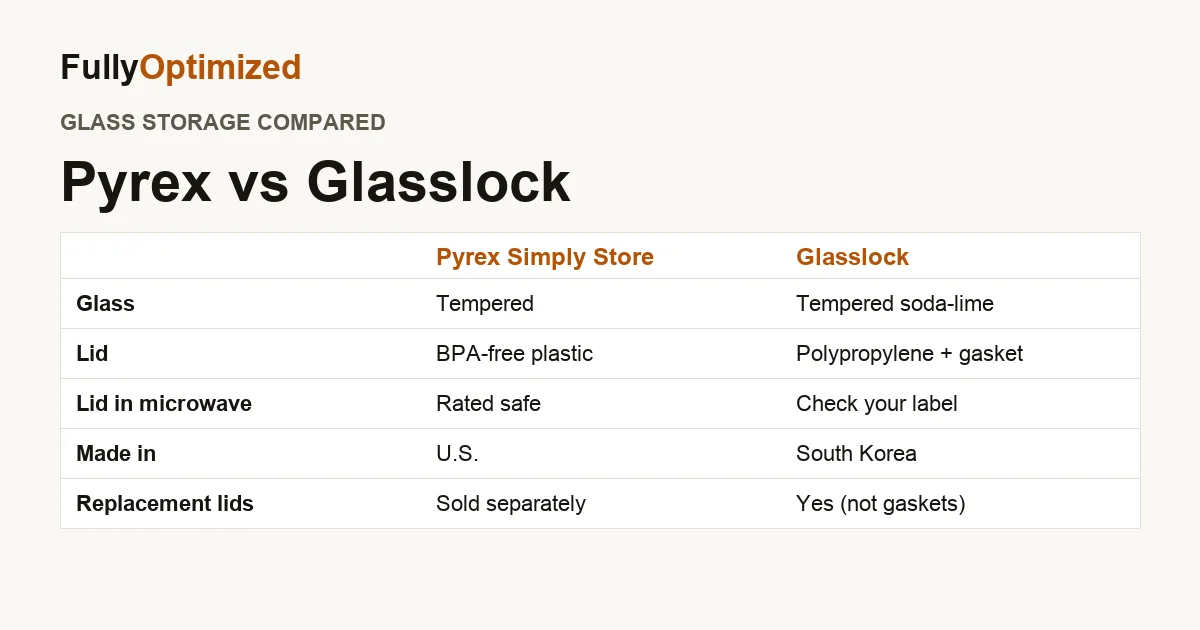
Side by side
| Pyrex Simply Store | Glasslock | |
|---|---|---|
| Glass | Heat-tempered glass[1] | Tempered glass from silica, soda ash and limestone[3] |
| Lid | BPA-free plastic, snug fit[1] | Polypropylene with a silicone gasket[3] |
| Lid in microwave | Rated microwave safe[1] | Follow the label on your set |
| Oven | Glass base only; preheat first (Pyrex care rules)[2] | Only the separate Oven Safe range[4] |
| Made in | U.S.[1] | South Korea[3] |
| Warranty or returns | 2-year limited warranty[1] | No warranty stated in its FAQ; 30-day returns on unused items[3] |
| Replacement lids | Sold separately on pyrexhome.com | Whole lids sold; gaskets not sold alone[3] |
The glass: closer than you think
The usual pitch is that one of these is "real" Pyrex-grade glass and the other is not. On the brands' own descriptions, both are tempered soda-lime glass. Pyrex calls its storage glass heat-tempered.[1] Glasslock lists silica, soda ash and limestone as its ingredients and calls the result tempered glass.[3] Neither is the borosilicate glass that older Pyrex, and PYREX sold in Europe, is known for.[5]
Tempering makes soda-lime glass much stronger against knocks, but it does not give it borosilicate's resistance to fast temperature swings. That is why both brands' care rules are strict about heat: preheat the oven, do not put hot glass on a wet or cold surface, and do not go from freezer to oven.[2] We go deeper on the difference in is borosilicate glass safe?.
The lids decide it
Since the glass is similar, choose by lid. The lid is also the part with moving pieces, so it is the part you are most likely to replace, and replacement options differ between the two brands.
Pyrex Simply Store
The lids press on rather than lock, and Pyrex rates both the glass and the BPA-free lid as microwave, freezer and top-rack dishwasher safe.[1] That makes it the easier daily reheat container. The trade-off is that Pyrex calls the lid snug-fitting, not leak-proof, so test it with water before trusting it with soup in a work bag.
- Lid rated for the microwave
- Made in the U.S., 2-year limited warranty
- Stacks with other Pyrex storage
- Lid is snug, not locking
- Tempered soda-lime glass: respect the heat rules
See Pyrex Simply Store (paid link)
Glasslock
Glasslock's polypropylene lids clamp down with a silicone gasket, which is what you want for liquids in a bag.[3] When a lid tab finally cracks, Glasslock USA sells a replacement lid, so you do not have to throw away the glass. It will not sell the gasket by itself.[3] If you want to bake in it, buy from the Oven Safe range rather than assuming every Glasslock piece can go in the oven.[4]
- Locking, gasketed lid for travel
- Replacement lids from the maker
- Oven use only on the Oven Safe range
- Gaskets are not sold separately
- More moving parts on the lid to crack
See Glasslock containers (paid link)
What about Snapware?
Snapware Total Solution is Pyrex glass with a four-latch lid, so it sits between the two. Pyrex sells the lids as airtight and leak-proof, but its own care notes say to unlatch and offset the lid in the microwave and that larger sizes may leak after prolonged microwave use.[2] See Snapware Total Solution (paid link)
Bottom line
If you are switching away from plastic for reheating, Pyrex Simply Store is the simpler buy. If you pack lunches with sauces or soup, Glasslock's locking lid fits better, and replacement lids keep it going. Either way you still have a plastic lid, so take it off or set it loosely on top in the microwave. Our plastic-free kitchen guide covers which plastic uses to drop first.
Common questions
Is Glasslock borosilicate glass?
No. Glasslock says its containers are tempered glass made from silica, soda ash and limestone, which is the recipe for soda-lime glass.
Is US Pyrex borosilicate?
Pyrex food storage sold in the U.S. is described by the brand as heat-tempered glass. Reporting by Gizmodo in 2019 found that, by nearly all accounts, Pyrex sold in the U.S. since 1998 has been tempered soda-lime glass. According to that 2019 reporting, PYREX in Europe is made by a different company and uses borosilicate.
Can Glasslock go in the oven?
Glasslock sells a separate Oven Safe range. Check that the set you buy belongs to it before baking, and never put the plastic lid in the oven.
Can I replace a broken Glasslock lid?
Yes. Glasslock USA sells replacement lids. Match the model number on the bottom of the container, which starts with RP or OC. It does not sell the silicone gaskets on their own.
Get new sleep and recovery reviews by email
One email when we publish a new hands-on review or a major update. No daily newsletter.
Sources
- Pyrex (Corelle Brands), Pyrex Simply Store 11-cup rectangle storage, product page (checked 2026-10-17)
- Pyrex (Corelle Brands), Snapware Total Solution Pyrex glass set, product page and use and care (checked 2026-10-17)
- Glasslock USA, What is Glasslock? (materials FAQ) (checked 2026-10-17)
- Glasslock USA, Oven Safe product range (checked 2026-10-17)
- Gizmodo, The Pyrex Glass Controversy That Just Won't Die (2019-03-16)