Sleep and recovery optimization: what actually has evidence
Research-based: built from manufacturer specs and published studies. Not a hands-on test.
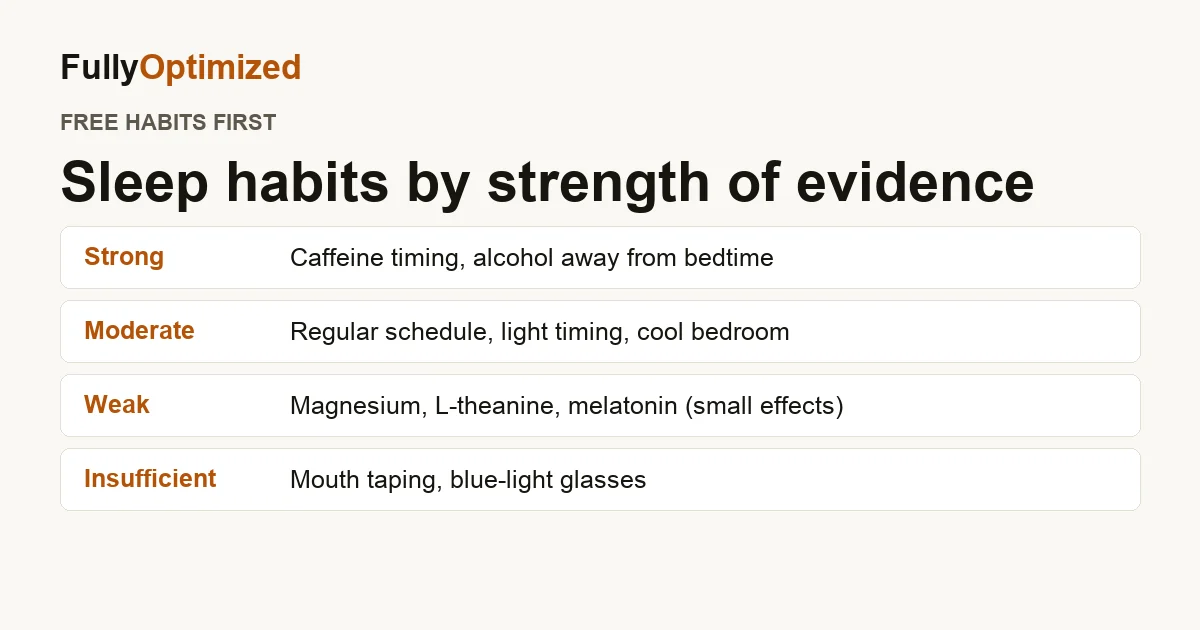
Most of what improves sleep costs nothing. The gear and supplements sold for sleep come further down the list, and the evidence for most of them is weaker than the marketing.
Start with the free, well-supported habits
Time your caffeine
A 2023 meta-analysis of 24 studies found caffeine cut total sleep by about 45 minutes and sleep efficiency by about 7%. To avoid losing sleep, it suggested a regular coffee at least 8.8 hours before bed and a large pre-workout dose at least 13.2 hours before.[1]
Keep alcohol away from bedtime
A 2025 meta-analysis of 27 studies found alcohol delayed and reduced REM sleep even at about two drinks, more so at higher doses.[2] This is the habit our own Oura made most visible; see our long-term Oura review.
Keep a regular schedule
In about 61,000 UK Biobank participants wearing accelerometers, more regular sleep was associated with 20 to 48% lower risk of death from any cause, and regularity predicted it better than sleep length did.[3] That is an association, not proof that regularity causes the benefit, but a steady bedtime is cheap to try.
Bright days, dim evenings, dark nights
An international expert consensus recommends bright light during the day, dimmer light for the three hours before bed, and darkness while you sleep.[4]
Do not let the bedroom get hot
A 2024 systematic review found that higher temperatures, indoors and out, are generally associated with worse sleep quality and quantity.[5] A warm bath or shower one to two hours before bed was linked to falling asleep faster in a meta-analysis, likely because it speeds the body's cooling afterwards.[6]
What trackers are good for
Consumer trackers are decent at how long and when you sleep, and rough on stages. A 2025 meta-analysis of 24 studies on wrist devices found they underestimated total sleep by about 17 minutes against lab sleep studies.[7] For the Oura ring, an independent meta-analysis of six studies found no significant average difference from lab measures, though stage estimates varied widely.[8] Use a tracker to see patterns and test changes, not to diagnose anything.
Supplements: smaller effects than the ads suggest
We will not recommend a supplement on thin evidence because it pays well. Here is where the research stands for the common ones.
- Melatonin: a meta-analysis of 19 trials found people fell asleep about 7 minutes faster.[9] The American Academy of Sleep Medicine suggests clinicians not use it for chronic insomnia.[10] In Canada, Health Canada's monograph covers adults 18 and over at 0.1 to 10 mg a day, taken as needed, and warns against driving for 5 hours after a dose and against use in pregnancy.[11]
- Magnesium: a meta-analysis of three small trials in older adults found modest effects, with low to very low quality evidence.[12]
- L-theanine: a 2025 meta-analysis of 19 trials found small improvements in self-reported sleep.[13]
Talk to a pharmacist or doctor before starting any of these, especially if you take medication or are pregnant.
Popular hacks with weak evidence
- Mouth taping: a 2025 review of 10 studies found little benefit and flagged a potential risk of serious harm.[14]
- Blue-light glasses: a 2023 Cochrane review found their effect on sleep uncertain.[15] Dimming the lights does the same job for free.
When to skip the gadgets and see someone
Loud snoring, gasping at night, insomnia that lasts weeks, or heavy daytime sleepiness need a clinician, not a ring or a supplement. Health Canada's melatonin monograph itself says to see a practitioner if sleeplessness lasts more than four weeks.[11]
Common questions
What is the most effective way to improve sleep?
The best-supported changes are free: time caffeine well before bed, keep alcohol away from bedtime, keep a regular sleep schedule, get bright light during the day and dim light in the evening, and avoid a hot bedroom. If you have ongoing insomnia, snoring or daytime sleepiness, see a clinician.
Are sleep trackers accurate?
For total sleep time and sleep timing, reasonably, in healthy adults. A 2025 meta-analysis found wrist trackers underestimated total sleep by about 17 minutes on average versus lab sleep studies. Stage estimates such as deep and REM sleep are much less reliable.
Does melatonin work?
A little. A meta-analysis of 19 trials found it helped people fall asleep about 7 minutes faster. The American Academy of Sleep Medicine suggests clinicians not use it for chronic insomnia. In Canada, Health Canada's monograph covers adults only, at 0.1 to 10 mg.
Does mouth taping help you sleep?
The evidence is thin and there are safety concerns. A 2025 review of 10 studies found little benefit and flagged a potential risk of serious harm. Snoring or gasping is a reason to get checked for sleep apnea.
Get new sleep and recovery reviews by email
One email when we publish a new hands-on review or a major update. No daily newsletter.
Sources
- Gardiner et al., Sleep Medicine Reviews, The effect of caffeine on subsequent sleep: A systematic review and meta-analysis (2023-06)
- Gardiner et al., Sleep Medicine Reviews, The effect of alcohol on subsequent sleep in healthy adults: A systematic review and meta-analysis (2025-04)
- Windred et al., Sleep, Sleep regularity is a stronger predictor of mortality risk than sleep duration: A prospective cohort study (2024-01-11)
- Brown et al., PLoS Biology, Recommendations for daytime, evening, and nighttime indoor light exposure to best support physiology, sleep, and wakefulness in healthy adults (2022-03)
- Chevance et al., Sleep Medicine Reviews, A systematic review of ambient heat and sleep in a warming climate (2024-06)
- Haghayegh et al., Sleep Medicine Reviews, Before-bedtime passive body heating by warm shower or bath to improve sleep: A systematic review and meta-analysis (2019-08)
- Lee et al., Journal of Clinical Sleep Medicine, Performance of consumer wrist-worn sleep tracking devices compared to polysomnography: a meta-analysis (2025-03-01)
- Khan et al., OTO Open, The Oura Ring Versus Medical-Grade Sleep Studies: A Systematic Review and Meta-Analysis (2025)
- Ferracioli-Oda et al., PLoS One, Meta-analysis: melatonin for the treatment of primary sleep disorders (2013)
- Sateia et al., Journal of Clinical Sleep Medicine (AASM guideline), Clinical Practice Guideline for the Pharmacologic Treatment of Chronic Insomnia in Adults (2017-02-15)
- Health Canada, Melatonin (oral) natural health product monograph (2025-12-19)
- Mah and Pitre, BMC Complementary Medicine and Therapies, Oral magnesium supplementation for insomnia in older adults: a Systematic Review and Meta-Analysis (2021-04-17)
- Bulman et al., Sleep Medicine Reviews, The effects of L-theanine consumption on sleep outcomes: A systematic review and meta-analysis (2025-06)
- Rhee et al., PLoS One, Breaking social media fads and uncovering the safety and efficacy of mouth taping in patients with mouth breathing, sleep disordered breathing, or obstructive sleep apnea (2025)
- Singh et al., Cochrane Database of Systematic Reviews, Blue-light filtering spectacle lenses for visual performance, sleep, and macular health in adults (2023-08-18)